Do You Need an AI Receptionist for Your Plumbing Business?
A burst pipe at 2 AM. The homeowner grabs their phone and calls the first plumber they find on Google. Nobody picks up. So they call the next one. And the next one. By the time your crew gets to the shop in the morning, that $3,000 emergency job belongs to someone else.
This is the reality for most plumbing businesses. You're under a sink, elbow-deep in a garbage disposal repair, and the phone buzzes in your pocket. You can't answer it. Your other tech is on a water heater install across town. There's no front desk, no office manager, no one to pick up that call. An AI receptionist for plumbers is built to fix exactly this problem, and it's changing how plumbing companies win new customers.
Mike runs a 4-truck plumbing company in Phoenix. His crew stays busy all day, but his phone goes to voicemail more than he'd like to admit. Last month, he tracked his missed calls for the first time: 47 in a single week. At roughly $1,200 per average plumbing job, that's over $56,000 in potential revenue walking straight to his competitors. Mike isn't bad at plumbing. He's just bad at answering the phone. And he's far from alone.
What happens when a plumbing customer can't get through?
A plumbing customer who can't reach you doesn't leave a voicemail. According to Forbes, roughly 80% of callers sent to voicemail simply hang up and call someone else. For plumbing businesses, this hits harder than most industries because the need is almost always urgent.
Think about it from the caller's side. Their kitchen is flooding. Their toilet won't stop running. Their water heater just died on the coldest day of the year. They're not browsing options, they're in crisis mode. They'll call two, maybe three plumbers. The first one who answers wins the job.
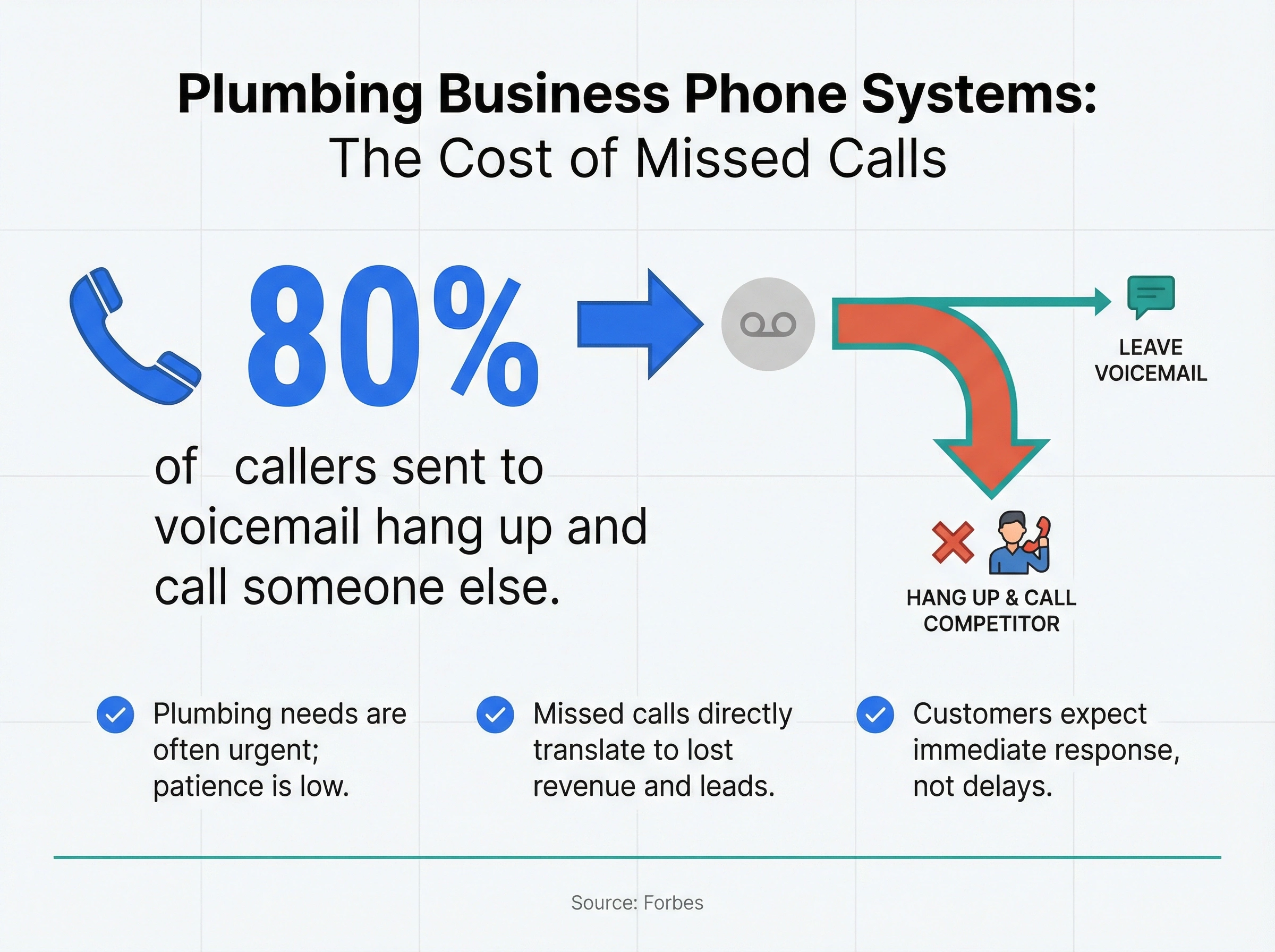
What do they do next? They go right back to Google and tap the next result. Your $200 marketing spend to get that click? Gone. The customer you worked to attract? Gone. And here's the worst part: you'll never even know they called.
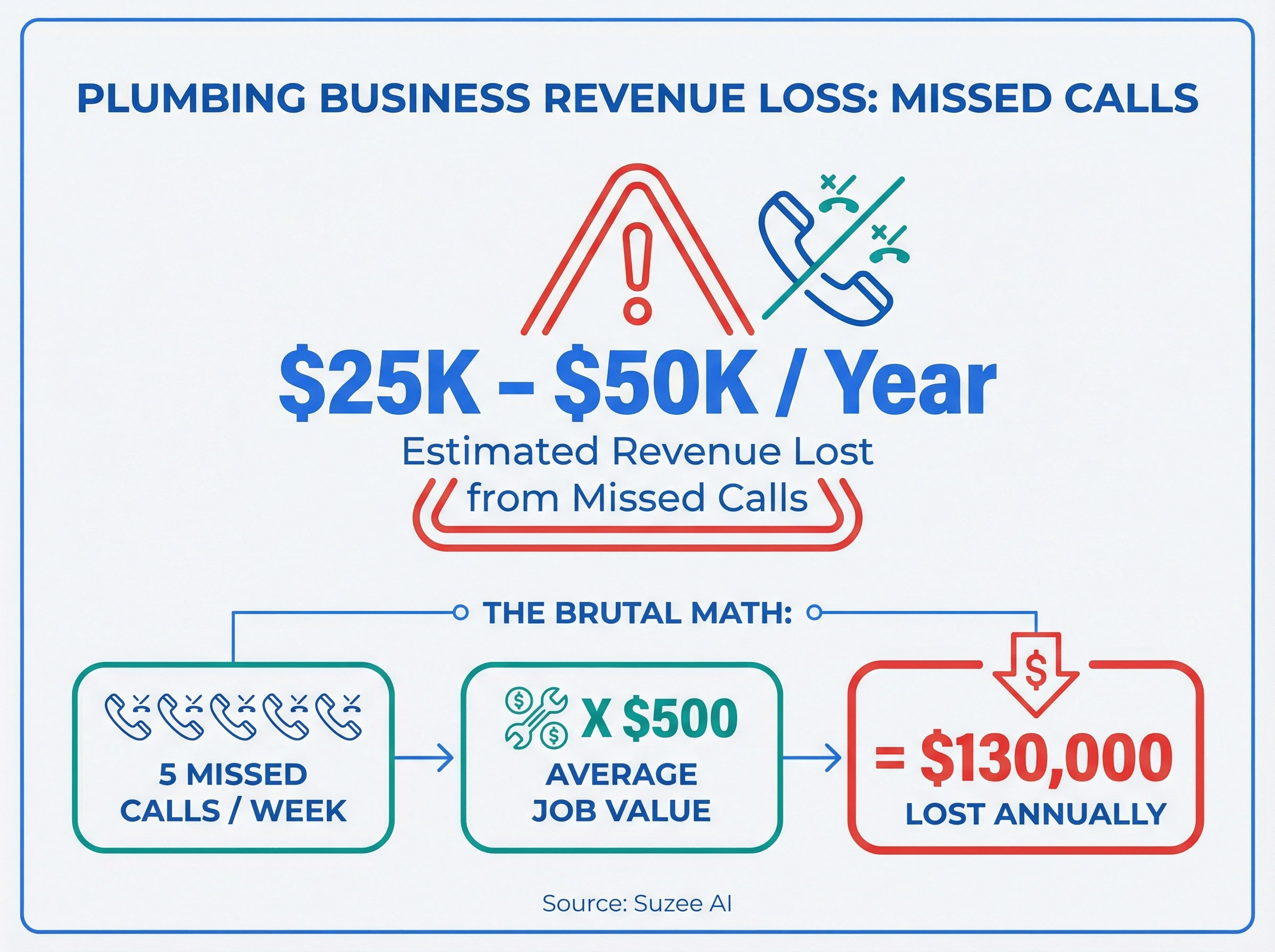
According to Suzee AI research, plumbing businesses lose between $25,000 and $50,000 per year from missed calls alone. Some shops with higher ticket jobs lose even more. The math is brutal: if you miss just 5 calls a week and each call represents a $500 average job value, that's $130,000 a year in lost revenue.
The problem gets worse during peak seasons. When spring thaw hits and frozen pipes start bursting, or when summer storms cause sewer backups, your call volume can double overnight. That's exactly when you're busiest on job sites and least able to answer the phone.
And it's not just emergency calls you're losing. A property manager who needs a plumber for a tenant's leaking faucet is calling during business hours. A homeowner who wants a quote on a bathroom remodel is calling on their lunch break. A restaurant owner who needs a grease trap cleaned is calling before the dinner rush. These are all scheduled, high-margin jobs that go to whoever picks up first.
The ripple effects go beyond just lost revenue. Every missed call is also a missed review, a missed referral, and a missed repeat customer. That one homeowner you didn't answer today? They would've called you again next year for the kitchen remodel. They would've told their neighbor about you. They would've left a 5-star Google review. One missed call, compounding losses for years.
Why do plumbing businesses struggle with phone calls?
Plumbing isn't a desk job. That's the fundamental challenge, and it's why traditional answering solutions have always been a poor fit for the trade.
Your techs are crawling under houses, working in crawl spaces, cutting through drywall, and handling tools that require both hands. Answering a phone call mid-job isn't just inconvenient, it's impractical and sometimes unsafe. And even when a tech does pick up, the background noise from a drain snake or torch makes the conversation hard to follow.
Here's what a typical day looks like for a small plumbing company:
6:30 AM - First calls start coming in. Customers want to book same-day appointments before they leave for work. Nobody's in the office yet.
8:00 AM - 5:00 PM - Your crew is on jobs. You might have one person handling dispatch, but they're also managing parts orders, coordinating schedules, and dealing with walk-ins. When three calls hit at once, two go to voicemail.
5:00 PM - 6:30 AM - Your phones are off. Or they ring into a voicemail box that customers won't use. Emergency calls from burst pipes, gas leaks, or sewer backups go unanswered for hours.
Weekends - Some of the highest-value emergency work happens on Saturday and Sunday. If you don't have weekend coverage, you're handing those $2,000+ emergency jobs to competitors who do.
According to Vocaly AI, about 30% of after-hours emergency calls to plumbing companies go to voicemail. Only 5% of those callers actually leave a message. The other 95% call someone else. Without an after-hours answering service, plumbers are essentially closed for business during the hours when emergencies happen most.
Hiring a full-time receptionist solves part of this, but creates new problems. A receptionist costs $35,000 to $45,000 a year in salary, plus benefits, training, and overhead. For a small shop running 2-4 trucks, that's a big expense for someone who only handles calls. And they still can't cover nights, weekends, or sick days without backup.
A plumbing answering service (the traditional kind with live operators) is another option, but it has its own issues. Operators don't know your schedule, your service area, or the difference between a running toilet and a gas leak. They take a message and promise a callback, which is exactly what the customer didn't want.
There's also the seasonal staffing challenge. Plumbing is cyclical. Winter brings frozen pipe calls. Spring brings sewer backup emergencies. Summer is water heater season. Your call volume can swing 200-300% between slow and busy months. A human receptionist costs the same in January as they do in July, whether you're getting 10 calls a day or 50.
Small plumbing businesses feel this the most. A solo plumber or a 2-person crew can't afford to stop working to answer phones, but also can't afford a full-time employee to sit in an office. It's a catch-22 that keeps a lot of plumbing businesses stuck at the same size year after year. They're great at the work, but they can't grow because they can't handle the volume of incoming calls.
What can an AI receptionist actually do for a plumbing company?
An AI receptionist for plumbers answers every call, 24 hours a day, 7 days a week, without putting anyone on hold. But saying "it answers calls" undersells what's actually happening.
Let's walk through what a real day looks like when a plumbing company runs an AI receptionist:
Tuesday, 6:15 AM - A homeowner's water heater pilot light went out overnight. They've got no hot water and need someone before work. The AI answers on the first ring, gathers the address, confirms the issue, and books a same-day appointment in your first available slot. Before your dispatcher even arrives, there's a confirmed job on the schedule.
Tuesday, 10:45 AM - A property manager calls about a leaking faucet in unit 4B. Not urgent, but they want it handled this week. The AI recognizes it's a non-emergency, checks your availability, and books a Thursday afternoon slot. Your techs never have to stop what they're doing.
Tuesday, 2:30 PM - Someone calls asking if you do tankless water heater installs and wants a rough price range. The AI provides general information about your services and captures their details for a callback from your office to discuss specifics and scheduling.
Tuesday, 11:00 PM - A restaurant owner discovers a sewage backup in their kitchen. The AI identifies this as an emergency, asks the right triage questions (is there standing water, any health hazard, is the space occupied), and immediately routes the call to your on-call tech's personal phone with all the details already captured.
Every single one of these interactions happened without a human receptionist. The AI handled routine bookings, answered service questions, and knew when to escalate an emergency. It also sent text confirmations to each caller and logged everything in your system.
This isn't science fiction. Modern AI receptionist software for plumbers can handle natural conversations, understand plumbing terminology, and make real-time decisions about urgency. It's a virtual receptionist for plumbers that works like a trained office manager who happens to never sleep.
Here's what makes AI different from a basic auto-attendant or phone tree. You know those "press 1 for scheduling, press 2 for emergencies" systems? Customers hate them. They want to talk, explain their problem, and get help. An AI receptionist has an actual conversation. The caller says "my toilet has been running for two days and now the floor is wet," and the AI understands that's more urgent than a standard toilet repair. It responds naturally, asks the right questions, and takes the right action.
The AI also learns your business over time. It knows you don't service a certain zip code. It knows you charge extra for weekend calls. It knows that when someone says "my water smells like eggs," they probably need a water heater inspection. These aren't features you have to program one by one. The system picks them up from how you set up your preferences and how calls play out.
For plumbing companies that work with property managers or commercial clients, the AI can recognize repeat callers and pull up their account. When the property manager for Oakwood Apartments calls, the AI already knows the address, the preferred service times, and the billing contact. That kind of personalized service used to require a dedicated office manager. Now it happens automatically.
The real cost of missed calls vs. an AI receptionist for plumbers
Let's get specific about the money. Plumbing businesses operate on tight margins, and every dollar matters. So is an AI receptionist worth the investment?
Here's a straightforward comparison:
| Expense | Full-time receptionist | Traditional answering service | AI receptionist |
|---|---|---|---|
| Monthly cost | $3,000 - $4,000 | $300 - $800 | $30 - $300 |
| After-hours coverage | No (unless you hire nights) | Yes (per-minute charges) | Yes (included) |
| Weekend coverage | No | Yes (premium rates) | Yes (included) |
| Books appointments directly | Yes | No (takes messages) | Yes |
| Handles 5+ simultaneous calls | No | Maybe (depends on staffing) | Yes |
| Knows your schedule | Yes | No | Yes |
| Sick days / vacation | 10-15 days off per year | N/A | Never |
The exact numbers vary depending on your market and job mix, but the pattern is consistent across every plumbing company we've talked to. An AI phone system for plumbing company operations costs 90-95% less than a human receptionist and captures calls that both options would miss.
But what's the alternative? Let's say you keep doing what you're doing. If you miss 10 calls per week (a conservative number for most shops) and just 3 of those would've converted to jobs averaging $800, that's $9,600 per month in lost revenue. An AI receptionist that costs $100-200 per month and captures even half of those calls pays for itself 15 to 20 times over.
From a marketing perspective, here's what really stings. According to WordStream, plumbing businesses spend $1,500 to $5,000 per month on Google Ads to generate leads. If 30-40% of those leads go to voicemail and never get a callback, you're essentially burning $450 to $2,000 a month on marketing for calls you won't answer.
An answering service for plumbing companies, whether AI or human, only works if it's available when your customers need you. The advantage of AI is that it's always on, handles multiple calls at once, and costs a fraction of any alternative.
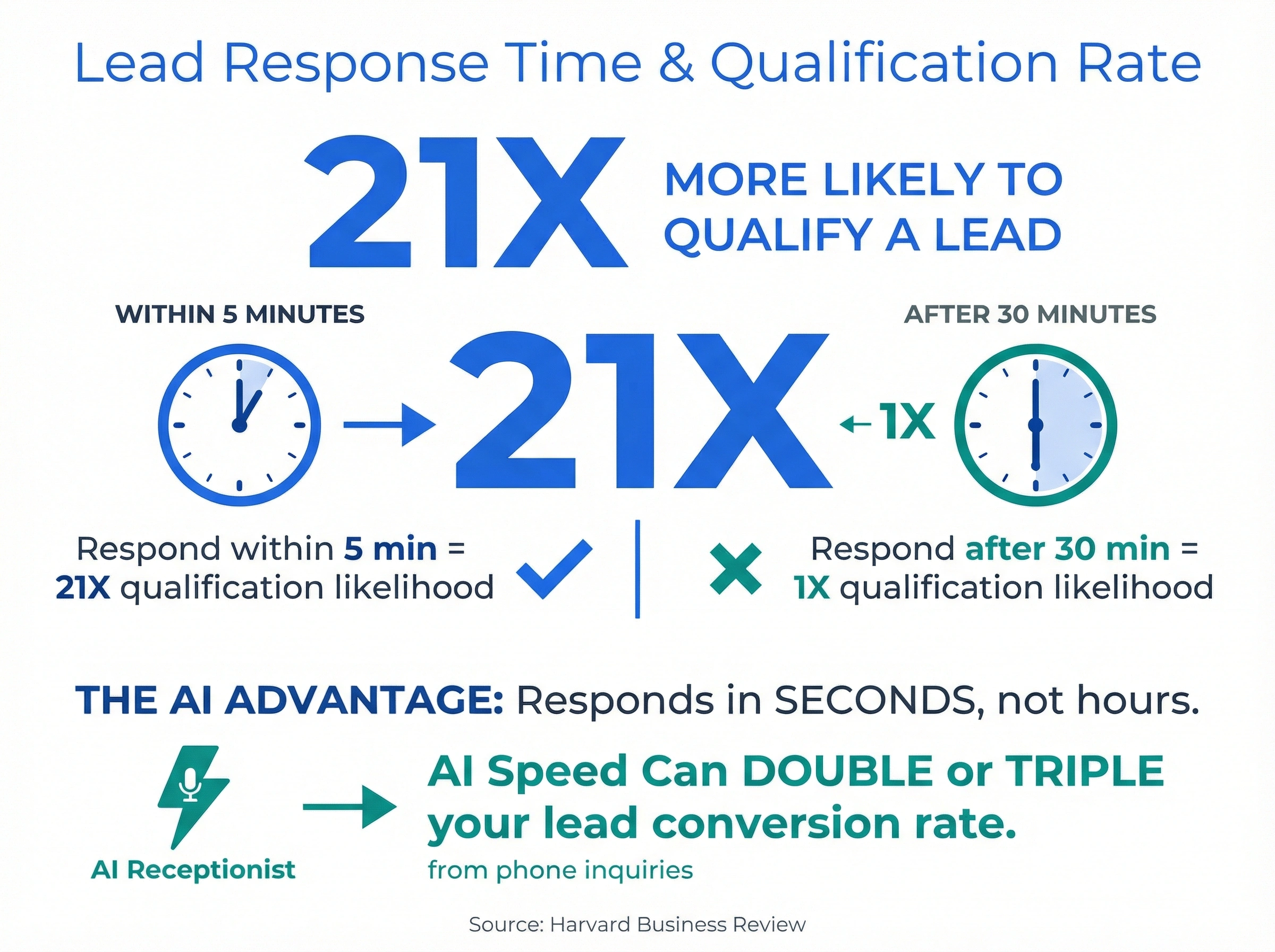
There's another cost most plumbing businesses don't think about: the cost of slow response times. Even when you do call people back, the conversion rate drops dramatically with every hour that passes. According to Harvard Business Review, businesses that respond to leads within 5 minutes are 21 times more likely to qualify that lead compared to those who respond after 30 minutes. An AI receptionist responds in seconds, not hours. That speed alone can double or triple your lead conversion rate from phone inquiries.
For a plumbing business doing $500,000 to $1 million in annual revenue, improving call capture by even 20% could mean an additional $100,000 to $200,000 in yearly revenue. That's the difference between staying a 3-truck operation and growing to 6 trucks. It's the difference between working on the business and just working in it.
How does an AI receptionist handle emergency plumbing calls?
This is the question we get most often from plumbing company owners, and it's the right question to ask. Plumbing emergencies are different from most industries. A burst pipe can cause thousands of dollars in water damage every hour. A gas leak is a safety hazard. A backed-up sewer in a restaurant can shut down operations.
A well-configured AI receptionist doesn't treat all calls the same. It triages based on urgency, and here's how that works:
Step 1: Identify the issue. The AI asks what's happening. If the caller says "my basement is flooding" or "I smell gas," the system immediately flags this as an emergency. It doesn't try to book a next-day appointment.
Step 2: Ask critical follow-up questions. For a water emergency: Is there standing water? Have you shut off the main water valve? For a gas-related call: Have you left the building? The AI can actually walk callers through basic safety steps while simultaneously alerting your team.
Step 3: Escalate to on-call staff. The call gets routed to your designated emergency contact, whether that's you, your lead tech, or a rotating on-call schedule. The AI sends along all the details: caller name, address, nature of emergency, and what the caller has already tried.
Step 4: If on-call doesn't answer. The system tries a backup number. If no one answers after the escalation chain, it takes the caller's info and sends urgent notifications via text and email to multiple team members.
Compare this to a voicemail box. A homeowner with a burst pipe calls at midnight, gets your recording about business hours, and hangs up. They call the next plumber. With an AI receptionist, that same call gets answered instantly, triaged correctly, and your tech gets a notification within seconds.
Is AI perfect at this? Not always. There are edge cases where a caller's description is vague, and the AI might not catch the urgency on the first exchange. But it's getting better fast, and it's already more reliable than a voicemail box or an after-hours answering service for plumbers where operators don't know a slab leak from a slow drain.
Here's a real scenario that shows why this matters. A homeowner calls at 10 PM on a Friday. They hear water running behind a wall but there's no visible leak. Is this an emergency? Maybe. A slow leak behind drywall can cause thousands in mold damage if it goes overnight. A trained AI asks clarifying questions: "Do you see any water on the floor? Is the wall warm or cool to the touch? Can you hear it constantly or does it come and go?" Based on the answers, it can classify this as urgent (route to on-call) or next-morning (book first appointment Saturday and text the customer a confirmation).
A voicemail box can't do that. A traditional answering service operator probably wouldn't ask those questions either. They'd write "caller hears water in wall" and leave it for Monday morning. By then, you've got a $15,000 mold remediation job on top of the pipe repair.
What plumbing companies get wrong about answering services
After working with businesses across dozens of industries, I've noticed plumbing companies make a few specific mistakes when it comes to phone management. And I'll be direct about this.
Honestly? Most plumbing businesses are spending thousands on marketing to drive calls they'll never answer. That's not a marketing problem. It's a phone problem. You can have the best Google Ads campaign, the highest Yelp rating, and the sharpest truck wraps in town. None of it matters if your phone rings five times and goes to voicemail.
Mistake #1: Thinking "they'll call back."
They won't. Plumbing customers need help now. Not tomorrow. Not after you finish the job you're on. Right now. The callback window in plumbing is about 5-10 minutes for emergencies and maybe an hour for non-urgent work. After that, they've already booked someone else.
Mistake #2: Having your techs answer the phone.
This sounds efficient, but it slows down their current job and leads to sloppy call handling. A tech who's mid-install and answers a call is going to rush through it, miss details, and forget to follow up. Plus, every minute on the phone is a minute not doing billable work.
Mistake #3: Only thinking about after-hours.
Yes, nights and weekends matter. But we've seen that a huge chunk of missed calls happen during business hours. Your dispatcher is on another call. Your office manager stepped out. Three calls come in at once and two go to voicemail. An AI calling receptionist software for plumbers handles all of these situations, not just the overnight ones.
Mistake #4: Using a generic answering service.
Traditional answering services take messages. That's it. They can't book appointments, they don't know your service area, and they certainly can't tell the difference between a dripping faucet and a sewer line collapse. A plumbing virtual receptionist built on AI actually understands context and makes decisions.
Why does this keep happening? Partly because phone management feels like a secondary concern. Plumbing companies focus on hiring great techs, buying the right equipment, and getting their name out there. The phone system is an afterthought. But it's the front door to your business, and leaving it unattended is like running a store with the door locked.
Mistake #5: Not tracking missed call data.
You can't fix what you don't measure. Most plumbing businesses have no idea how many calls they miss. They don't know what time of day is worst, which days are busiest, or how many of those missed calls were high-value emergency jobs. An answering service for plumbers with built-in analytics changes that. You get data on call volume, peak times, common service requests, and conversion rates. That data helps you make smarter decisions about staffing, marketing spend, and service area coverage.
If you're running Google Ads, for example, knowing that 60% of your ad-generated calls come in between 6 PM and 9 PM tells you exactly when you need an AI receptionist working hardest. If most of your missed calls are for water heater installs, you know where to focus your marketing. The phone isn't just a communication tool, it's a data source, and most plumbing companies are ignoring it entirely.
How dialnote helps plumbing businesses answer every call
dialnote was built for exactly the kind of challenges plumbing companies face every day. It's not a generic phone tool, it's a complete plumbing business phone system designed to make sure you never miss another call.
Here's what makes it work for plumbers specifically:
AI receptionist that understands plumbing. dialnote's AI doesn't just read a script. It handles real conversations about water heaters, drain cleaning, pipe repair, and emergency calls. Callers talk naturally, and the AI responds with relevant information and next steps. It books appointments, captures job details, and routes emergencies to your on-call tech.
24/7 coverage without the overhead. Your AI receptionist works nights, weekends, and holidays. When that 2 AM burst pipe call comes in, dialnote answers, triages, and connects the caller with your emergency crew. No voicemail. No delays. No lost jobs.
Business text messaging built in. After a call, dialnote can automatically text the customer a confirmation with your company name, appointment time, and any pre-visit instructions (like turning off the water main). This keeps customers informed and reduces no-shows.
Handle multiple calls at once. During peak seasons when your phone is ringing nonstop, dialnote handles every call simultaneously. Five calls at the same time? No problem. No hold music, no busy signals, no missed opportunities.
Works with your existing number. Already have a business number your customers know? You can port your phone number to dialnote without any downtime. Same number, better system.
Simple call routing. Route calls based on time of day, caller location, or job type. Emergency calls go straight to your on-call tech. Routine booking requests get handled by the AI. Vendor calls get sent to your office line. Learn more about how call routing works.
The plumbing companies already using dialnote report capturing 30-50% more leads per month just from answering calls they used to miss. For a business where each job averages $500-$1,500, that adds up fast.
If you're spending money on marketing but losing leads to voicemail, dialnote's AI answering service is probably the highest-ROI investment you can make right now. You can check pricing plans to find one that fits your shop size.
Your plumbing business won't grow if nobody can reach you
You can have the best techs in town. You can run the cleanest trucks, show up on time, and do excellent work. But if a customer can't get through to you when they need a plumber, none of that matters.
The plumbing companies that are growing right now aren't necessarily the best at plumbing. They're the ones that answer every call. They respond to emergencies at midnight. They book appointments while their techs are on job sites. They don't let a single lead slip through the cracks.
An AI receptionist for plumbers isn't about replacing people. It's about making sure your plumbing business phone system works as hard as you do. It picks up the calls you can't, books the jobs you'd otherwise lose, and handles emergencies when your team is asleep.
The tools exist. The cost is minimal compared to what you're losing. The only question is how many more calls you're willing to miss before you do something about it.
Frequently asked questions
An AI receptionist answers calls 24/7, books appointments, captures job details, and routes emergencies to your on-call tech. It handles natural conversations about plumbing issues and makes real-time decisions about urgency.
Yes. It identifies emergencies like burst pipes or gas leaks, asks triage questions, and immediately routes the call to your on-call staff with all details. It can also walk callers through basic safety steps.
AI receptionist services typically cost $30-$300 per month, compared to $3,000-$4,000 for a full-time human receptionist. Most plumbing businesses see ROI within the first month from captured calls alone.
Modern AI receptionists have natural-sounding conversations and understand plumbing terminology. Most callers don't realize they're talking to AI because it responds contextually, not from a rigid script.
Yes. It checks your availability, books appointments in open time slots, sends text confirmations to customers, and logs everything in your system. Your team doesn't need to return calls for routine bookings.

Written by
Lancelot Dsouza
Chief Marketing Officer, SmartReach.io
Lancelot Dsouza is the Chief Marketing Officer at SmartReach.io, where he built the Marketing, Sales, and Customer Success verticals from the ground up. With over 25 years of experience spanning digital marketing, business development, and strategic...
Lancelot Dsouza is the Chief Marketing Officer at SmartReach.io, where he built the Marketing, Sales, and Customer Success verticals from the ground up. With over 25 years of experience spanning digital marketing, business development, and strategic...
Related Articles

Best AI Receptionist Software For Businesses Ranked
Compare the best AI receptionist software for businesses by 10-user cost, per-minute AI fees, IVR, call queueing, and real reviews. Pick the right tool.

Does Your Business Need an After Hours Answering Service?
Learn how an after hours answering service captures missed calls, compare pricing for live vs AI options, and set up 24/7 coverage for your business.
AI Phone Answering Service vs Virtual Receptionist?
Compare AI phone answering services and virtual receptionists side by side. Find which option fits your business, budget, and call volume.