How Can an AI Receptionist Grow Your Electrical Business?
Every missed call costs your electrical business somewhere between $200 and $2,500. That's not a guess. It's the average range of a residential electrical service call, from a tripped breaker fix to a full panel upgrade. And most electricians miss at least 5 to 10 calls every single week.
An AI receptionist for electricians picks up every one of those calls. No voicemail. No "we'll call you back." No lost jobs walking straight to the competitor down the road.
Dave runs a 3-truck electrical company in Dallas. His crew is skilled, reliable, and booked solid from 7 AM to 5 PM. But when he started tracking his missed calls last quarter, the numbers hit hard: 38 missed calls in a single month. At an average job value of $800, that's over $30,000 in potential revenue that never got a chance to convert. Dave isn't a bad electrician. He's just a busy one. And his phone doesn't care how good his wiring is.
If your electrical business is in the same spot, an AI receptionist for electricians changes the equation entirely. Let's break down how it works, what it costs, and why it might be the best growth investment you haven't made yet.
Why do electricians miss more calls than other trades?
Electricians face a unique set of obstacles when it comes to answering the phone, and it goes beyond just being busy. It's about where you are and what you're doing when that call comes in.
You're 20 feet up a ladder, pulling wire through an attic in July. Your phone buzzes in your pocket. You can't answer it. You're wearing insulated gloves, standing on a fiberglass ladder, with both hands feeding Romex through a junction box. Even if you wanted to stop, it would take 3 to 5 minutes just to climb down safely.
Or you're inside an electrical panel, tracing a circuit that keeps tripping. Your hands are full, your concentration is locked in, and stopping mid-diagnosis means starting over. The phone rings. You let it go.
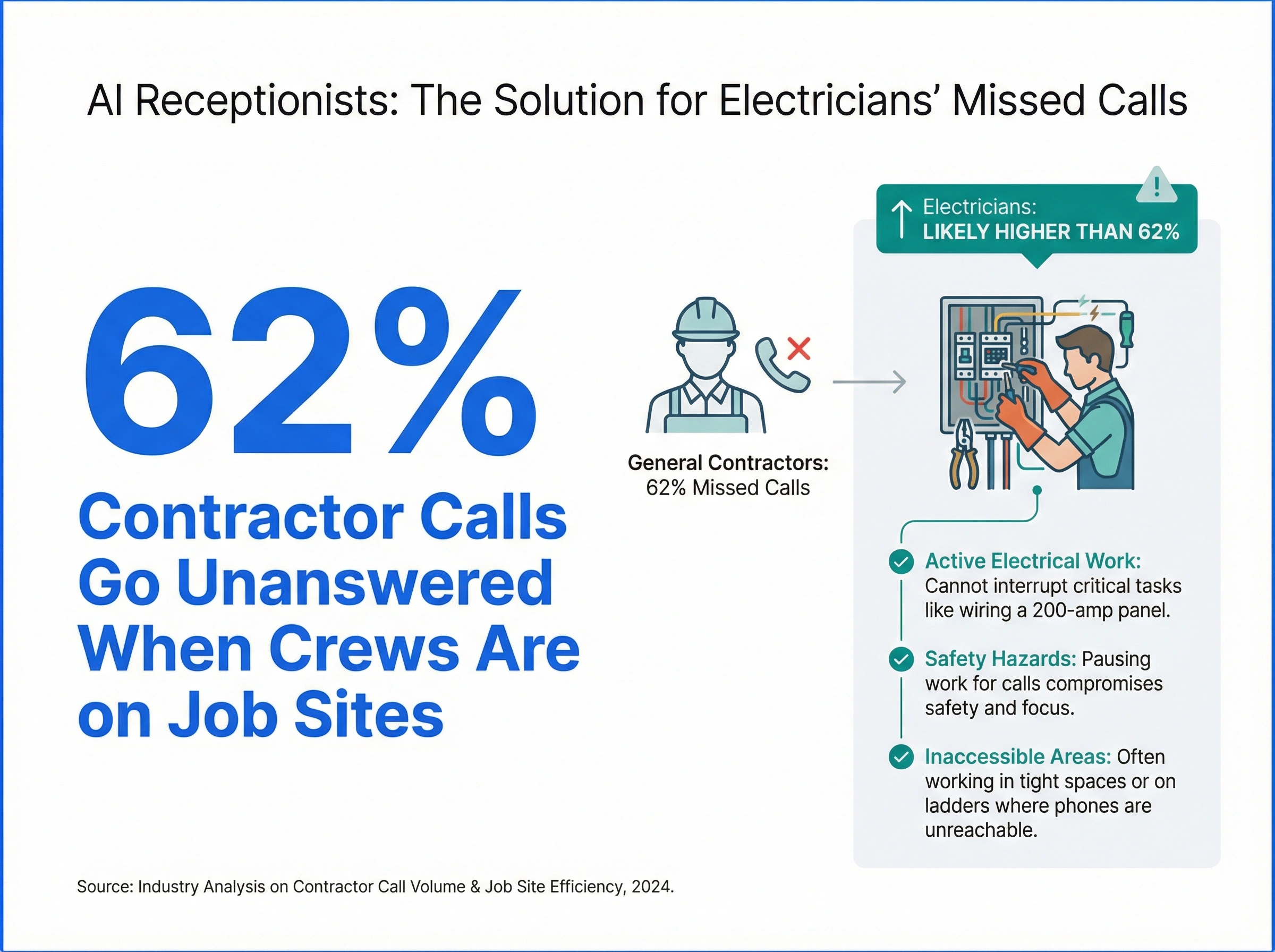
According to a study tracked by Medium, about 62% of calls to contractors go unanswered when crews are on job sites. For electricians, that number is likely higher because of the physical nature of the work. You can't pause in the middle of wiring a 200-amp service panel to chat about someone's flickering kitchen lights.
Here's what makes it worse. Unlike a plumber who might be working at floor level near their truck, electricians spend their days in the hardest-to-reach spots in a building. Attics in the summer. Crawl spaces. Drop ceilings. Breaker closets tucked behind storage rooms. The noise from drills, reciprocating saws, and exhaust fans makes it hard to even hear a phone ring, let alone hold a conversation.
And if you're a solo electrician or running a 2-person crew, there's nobody else to pick up. You don't have a front office. You don't have a dispatcher. Your "reception desk" is your back pocket, and it goes to voicemail more than you'd like to admit.
Then there's the seasonal factor. Electrical work isn't steady all year. Storm season brings a surge of calls for surge protector installs and damage repairs. Summer drives demand for ceiling fan installs and AC circuit additions. The holidays bring calls for outdoor lighting setups. And every spring, homeowners start renovation projects that need electrical permits. Your busiest months are also the months when you're least able to answer the phone.
Hiring a full-time receptionist sounds like a fix, but the math doesn't always work for a small electrical company. A receptionist costs $35,000 to $45,000 a year in salary plus benefits and overhead. For a shop running 2 to 4 trucks, that's a big line item for someone who only handles calls. And they still can't cover nights, weekends, or those 6 AM calls from homeowners who woke up with no power.
According to data from CallBird AI, the average small contracting business loses $45,000 to $120,000 per year just from unanswered phone calls. For electrical companies with higher-ticket work like panel upgrades, EV charger installs, or commercial wiring, that number climbs even higher. Pest control companies face the same challenge with seasonal call spikes.
5 types of calls your electrical business is missing right now
Not all missed calls are equal. Some cost you a $150 outlet repair. Others cost you a $15,000 commercial contract. Here's a breakdown of the five call types that are slipping through the cracks, and why each one matters more than you'd think.
1. Emergency calls that can't wait
A homeowner smells something burning near their breaker box at 9 PM. A restaurant's lights just went out during dinner service. A property manager has a tenant with no power in January.
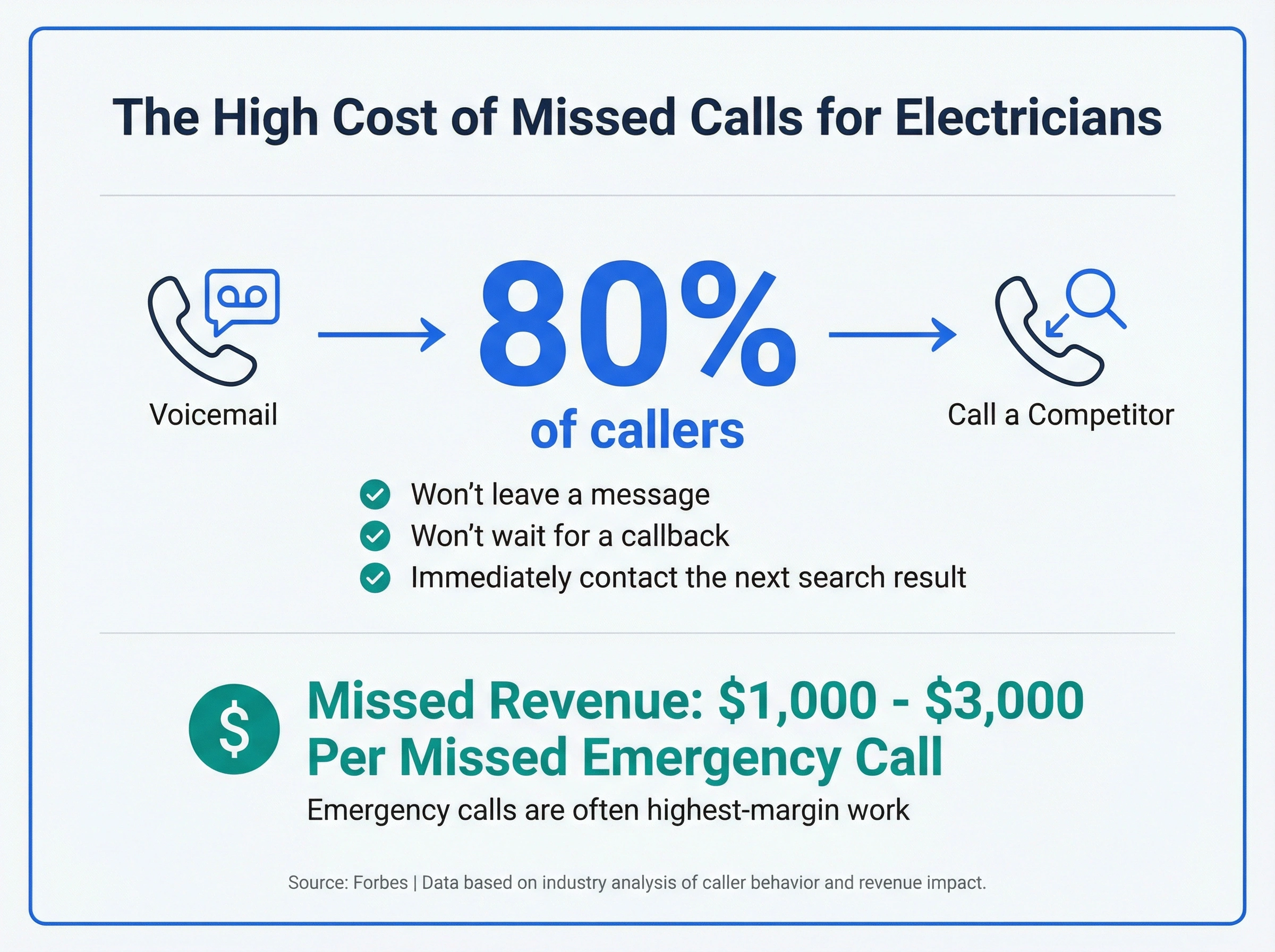
These callers aren't browsing. They need an electrician right now. And according to Forbes, roughly 80% of callers sent to voicemail simply move on to a competitor. They won't leave a message. They won't wait for a callback. They'll hang up and tap the next search result.
Emergency electrical calls are often your highest-margin work. After-hours rates, weekend premiums, and the urgency of the situation all push the ticket value up. Missing a single emergency call can cost you $1,000 to $3,000 in revenue, and you'll never even know it happened.
2. Estimate and quote requests
A homeowner wants a quote for a full-house rewire. A small business needs pricing on LED retrofit lighting for their office. A general contractor needs an electrician to bid on the rough-in work for a new build.
These callers are comparing options. They're calling 2 or 3 electricians and going with the first one who picks up and gives a clear answer. If your phone goes to voicemail, you're not even in the running. The decision was made before you got the chance to compete.
Quote calls have another hidden cost: each one represents a customer who did their research, chose your company, and made the effort to call. Your SEO, your Google Business profile, your reviews, all of that work brought them to the point of calling. Letting it ring through undoes all of it.
3. Existing customer callbacks and follow-ups
Your repeat customers are your most valuable customers. They already trust you. They've already paid you. When their outdoor lighting stops working or they need an outlet added in the garage, they call you first.
But if you miss that call, they might not try again. They'll ask a neighbor for a recommendation or search online instead. You just lost a customer who would've given you easy, profitable work for years. Repeat customers are also your best source of reviews and referrals. Losing even one has a ripple effect you won't see until months later.
4. Commercial and property management inquiries
Property managers and commercial clients represent recurring revenue. A property management company that calls about electrical issues in their buildings could turn into a long-term maintenance contract worth thousands per year. A restaurant chain looking for a reliable electrician for multiple locations is the kind of account that transforms a small business.
These callers expect professionalism. If they reach voicemail, they assume you're too small or too disorganized to handle their account. They move on fast and rarely call back.
5. Referral calls from past customers
When a happy customer tells their friend "call my electrician," that referral call is already half-sold. The trust is built in. The close rate on referral leads is dramatically higher than cold leads from ads or search.
But that referral caller doesn't know you personally. If they call and get voicemail, they don't have the same loyalty your original customer does. They'll try once, get no answer, and move on. Your reputation delivered the lead, but your phone killed it.
How many of these calls are you missing every week? Even a rough count would probably surprise you.
What happens when you answer every call vs. when you don't?
Let's put two identical electrical businesses side by side. Same skills, same service area, same marketing budget. The only difference is that one answers every call. The other misses about a third.
The electrician who answers every call:
- Books 15 to 20 jobs per week from inbound calls
- Converts emergency calls into same-day revenue at premium rates
- Builds a steady pipeline of estimate requests that close within a week
- Retains repeat customers who always get through on the first try
- Gets 5-star Google reviews because the customer experience starts strong from that very first call
- Grows from 3 trucks to 6 within two years
The electrician who misses a third of calls:
- Books 10 to 13 jobs per week (same marketing spend, fewer conversions)
- Loses emergency jobs to competitors who answer at midnight
- Returns quote calls 4 to 6 hours late, after the customer has already hired someone else
- Slowly loses repeat customers who get tired of hitting voicemail
- Gets fewer reviews because fewer customers complete the full experience
- Stays at 3 trucks, wondering why growth has stalled
The gap between these two businesses isn't talent. It's phone coverage.
Let's make it more concrete. It's a Tuesday evening at 7 PM. A homeowner's outdoor GFCI outlet keeps tripping and their holiday lighting setup won't stay on. They've got a party this weekend. They call two electricians.
Electrician A has an AI receptionist. It answers on the first ring, understands the issue, asks if there are any other outlets affected, and books a Wednesday morning appointment. The homeowner gets a text confirmation 10 seconds later. Done.
Electrician B's phone rings four times and goes to voicemail. The homeowner hangs up without leaving a message. They don't call back the next day. They've already booked Electrician A.
That one call was worth $350. Multiply it by 3 similar scenarios per week, and that's $54,600 per year in revenue that went to the electrician who just answered the phone.
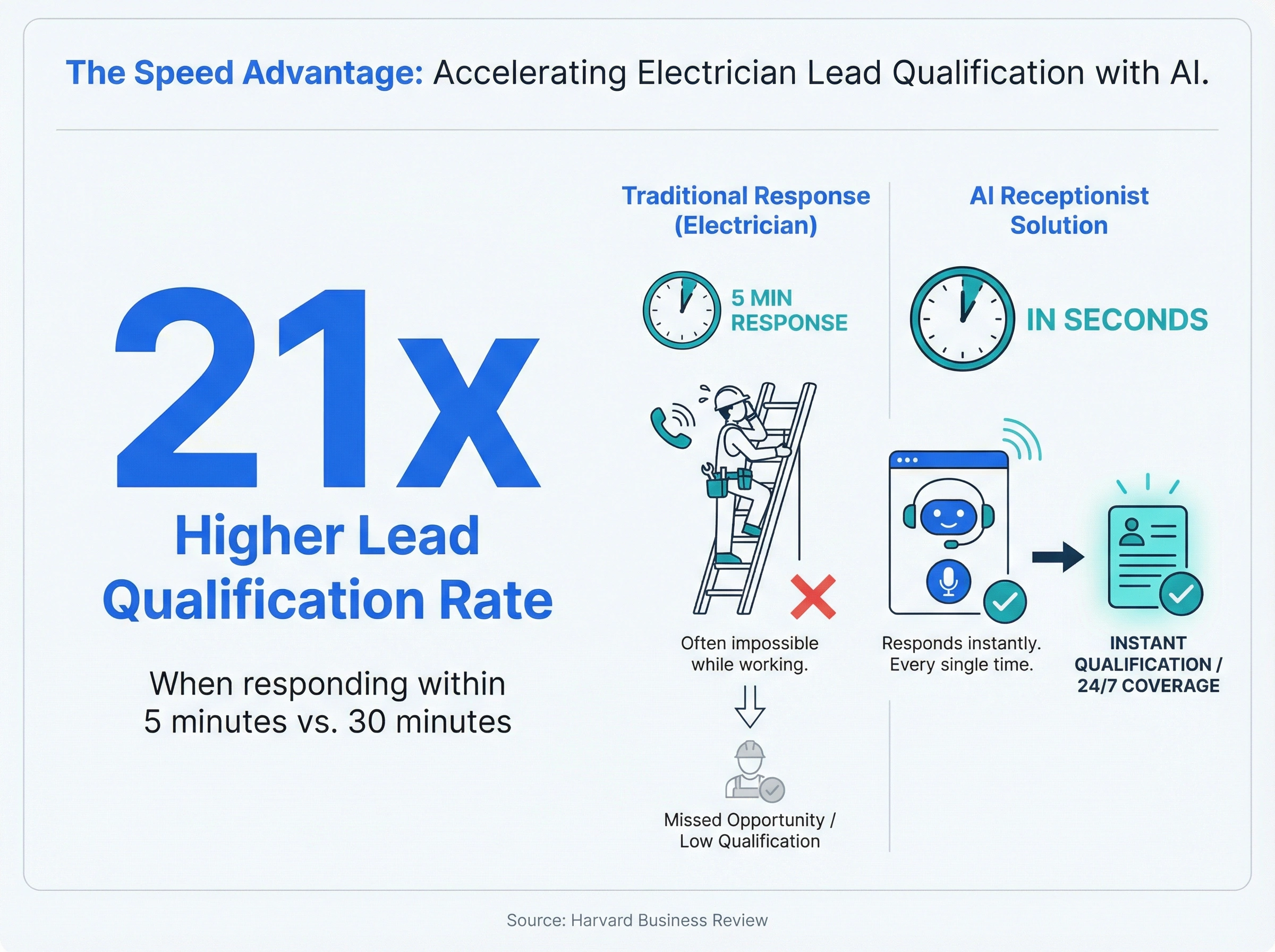
According to Harvard Business Review, businesses that respond to leads within 5 minutes are 21 times more likely to qualify that lead compared to those who respond after 30 minutes. For an electrician up a ladder, responding in 5 minutes is nearly impossible. But an AI receptionist responds in seconds. Every single time.
Honestly? Most electricians spend thousands on Google Ads and then let half those leads ring out to voicemail. That's not a marketing problem. That's a phone problem. And it's the easiest one to fix.
How does an AI receptionist handle electrical service calls?
An AI receptionist for electricians doesn't play a greeting and take a message. It has a real conversation with the caller, figures out what they need, and takes the right next step. Here's what a typical day looks like:
Monday, 6:30 AM: A homeowner's power went out overnight and they need someone before they leave for work. The AI answers on the first ring, asks what's happening (partial outage? whole house? any burning smell?), and books a same-day appointment in your first open slot. It texts the customer a confirmation with your company name and estimated arrival window. Your dispatcher sees a new job on the schedule before they've finished their coffee.
Monday, 11:00 AM: A small business owner calls about adding 3 dedicated circuits for new equipment in their warehouse. Not urgent, but they want it done this month. The AI gathers the details (type of equipment, voltage requirements, address) and books a site visit for later in the week. It logs everything so your tech knows exactly what to expect before they show up.
Monday, 3:15 PM: Three calls come in at the same time. One is a quote request for a panel upgrade. One is a property manager reporting a unit that has no power. One is a past customer asking if you install EV chargers. The AI handles all three simultaneously. No hold music. No busy signal. No missed calls. Each caller gets a natural conversation and a clear next step.
Monday, 10:30 PM: A homeowner calls about a sparking outlet in their kitchen. The AI recognizes this as a potential fire hazard. It asks if the sparking has stopped, whether they can see any scorch marks, and walks them through locating and turning off the breaker for that circuit. Then it immediately routes the call to your on-call electrician's phone with the full details: caller name, address, nature of the emergency, and what the caller has already done. Your tech has everything they need before they even answer the transfer.
Every one of these interactions happened without a human receptionist. The AI booked routine work, answered service questions, triaged an electrical emergency, and sent text confirmations. And it logged every detail for your records.
What makes this different from the old "press 1 for scheduling, press 2 for emergencies" phone trees? Callers hate those systems. They want to explain their problem in plain language. An AI receptionist listens, understands context, and responds naturally. When someone says "my lights keep flickering and I smell something weird near the panel," the AI knows that's not a routine appointment. It escalates immediately.
Hard to say if this works exactly the same for every electrical shop, but the pattern across the businesses we've spoken to is consistent. The AI gets better over time as it learns your specific service area, pricing structure, and scheduling preferences. After a few weeks, it handles calls like an office manager who's been with your company for years.
For electrical businesses with commercial clients, the AI can recognize repeat callers. When the facilities manager at the office park calls for the third time this quarter, the AI already knows the building address, the preferred service window, and the billing contact. That level of recognition used to require a dedicated employee. Now it happens automatically.
The AI also handles the calls that aren't emergencies but still matter. Someone asking what your service area covers. A homeowner wondering if you do ceiling fan installs. A contractor checking if you're licensed for commercial work. These small calls add up, and each one is a potential job. An answering service for electricians that can handle these conversations without bothering you on the job site is worth its weight in copper wire.
Is an AI receptionist for electricians worth the investment?
So what does the math actually look like? Let's break it down, because this is where most electrical business owners hesitate. The monthly cost seems low, but they want proof before they commit.
Here's a side-by-side cost comparison:
| Expense | Full-time receptionist | Traditional answering service | AI receptionist |
|---|---|---|---|
| Monthly cost | $3,000 to $4,000 | $300 to $800 | $30 to $300 |
| After-hours coverage | No (unless you hire nights) | Yes (per-minute charges) | Yes (included) |
| Weekend coverage | No | Yes (premium rates) | Yes (included) |
| Books appointments directly | Yes | No (takes messages) | Yes |
| Handles 5+ simultaneous calls | No | Maybe (depends on staffing) | Yes |
| Knows your schedule | Yes | No | Yes |
| Sick days and vacation | 10 to 15 days off per year | N/A | Never |
Now let's look at the return side. Say you're missing 10 calls per week. That's a conservative number for most electrical businesses during busy months. If just 4 of those calls would've converted to jobs averaging $700 each, that's $2,800 per week in lost revenue. That adds up to $11,200 per month. Or $134,400 per year.
An AI receptionist that costs $150 per month and captures even half of those missed calls generates a return of roughly 35 to 1. That's not a rounding error. That's a number that should make you stop and reconsider your current phone setup.
There's also the marketing efficiency angle. If you're spending $2,000 per month on Google Ads to generate electrical leads, and 30% of those ad-driven calls go unanswered, you're burning $600 per month on advertising for calls nobody picks up. An AI receptionist doesn't just pay for itself. It makes every other marketing dollar work harder.
Don't bother with a traditional answering service unless you're fine with operators who can't tell the difference between a tripped GFCI and a dead service panel. They take messages. That's it. They can't book your appointments, they don't know your service area, and they definitely can't walk a panicking homeowner through shutting off a breaker during a late-night emergency. An automated receptionist built for electrical businesses handles all of that.
For solo electricians, the math is even simpler. You physically can't answer the phone while you're working. Full stop. No amount of motivation changes the fact that you can't hold a phone while you're pulling wire through conduit. An AI receptionist is essentially your office staff at a fraction of what even part-time help would cost. It picks up every call, qualifies the lead, and puts a job on your schedule so you can focus on the work that actually generates revenue.
And there's one more cost that most electricians don't think about: the cost of slow response. Even when you do return calls, every hour that passes cuts your conversion rate. A callback at 5 PM for a call that came in at 10 AM means the customer already hired someone else. An AI receptionist eliminates that delay completely. The caller gets a response in seconds, not hours.
How dialnote solves the phone problem for electricians
dialnote was built for businesses that can't afford to miss calls but also can't sit by the phone. For electricians, that's basically every working day.
Here's what dialnote brings to your electrical business:
AI receptionist that understands electrical work. dialnote's AI receptionist handles natural conversations about panel upgrades, outlet installs, circuit additions, lighting issues, and electrical emergencies. Callers describe their problem in their own words, and the AI understands the context, asks the right follow-up questions, and takes action. It books appointments, captures job details, and knows when to route an emergency call to your on-call electrician immediately.
24/7 coverage without the overhead. When that 11 PM sparking outlet call comes in, dialnote answers, triages the situation, and connects the caller to your emergency crew. No voicemail. No delays. No lost jobs. Your virtual receptionist for electricians works nights, weekends, holidays, and storm season surges without asking for overtime.
Business text messaging built in. After every call, dialnote can automatically text the customer a confirmation with your company name, appointment time, and any pre-visit instructions. This keeps customers informed and cuts down on no-shows. Your customers feel taken care of from the moment they call.
Handles multiple calls at once. Storm damage drives a spike in calls. A neighborhood-wide outage sends 10 homeowners reaching for their phones at the same time. dialnote handles every call simultaneously. No hold music, no busy signals, no lost opportunities.
Smart call routing. Route calls based on time of day, urgency, or job type. Emergency calls go straight to your on-call tech. Routine booking requests get handled by the AI. Vendor and supplier calls go to your office line. Call management that actually works for a business where nobody sits at a desk.
Works with your existing number. Already have a business number that's on your trucks, your cards, and your Google listing? Port your phone number to dialnote without any downtime. Same number, better system.
Call analytics that show you the full picture. Track call volume, peak hours, common service requests, and how many calls you'd be missing without AI coverage. Call analytics give you the data to make smarter decisions about staffing, marketing spend, and which services to push during specific seasons.
The electrical businesses already using dialnote report capturing 30 to 50% more leads per month just from answering calls they used to miss. For a company where each job averages $500 to $1,500, that adds up fast.
If you're spending money on marketing but losing leads to voicemail, dialnote's AI answering service is probably the highest-ROI investment you can make right now. You can check pricing plans to find one that fits your business size.
Your electrical business can't grow on missed calls
You can be the most skilled electrician in your market. You can run clean jobs, show up on time, pull permits properly, and leave every customer impressed. But none of that matters if the next customer can't reach you when they need an electrician.
The electrical companies that are growing right now aren't necessarily the best at pulling wire. They're the best at answering the phone. They capture emergency calls at midnight. They book estimates while their techs are on job sites. They don't let a single lead slip away because nobody picked up.
An AI receptionist for electricians isn't about replacing people. It's about making sure your electrician phone system works as hard as your crew does. It answers the calls you can't, books the jobs you'd otherwise lose, and handles emergencies when your team is off the clock.
The tools are here. The cost is a fraction of what you're losing right now. The only question is how many more calls you're willing to miss before you fix the one thing that's holding your business back.
Frequently asked questions
An AI receptionist answers calls 24/7, books appointments, captures job details, and routes emergencies to your on-call electrician. It handles natural conversations about electrical issues and takes action based on urgency.
Yes. It identifies hazards like sparking outlets or power outages, walks callers through safety steps like shutting off the breaker, and immediately routes the call to your on-call tech with full details.
AI receptionist services typically cost $30 to $300 per month, compared to $3,000 to $4,000 for a full-time human receptionist. Most electrical businesses see ROI within the first month from captured calls alone.
Modern AI receptionists have natural-sounding conversations and understand electrical terminology. Most callers don't realize they're talking to AI because it responds based on context, not a rigid script.
Yes. It checks your availability, books appointments in open slots, sends text confirmations to customers, and logs everything in your system. Your crew doesn't need to stop working to handle routine bookings.

Written by
Lancelot Dsouza
Chief Marketing Officer, SmartReach.io
Lancelot Dsouza is the Chief Marketing Officer at SmartReach.io, where he built the Marketing, Sales, and Customer Success verticals from the ground up. With over 25 years of experience spanning digital marketing, business development, and strategic...
Lancelot Dsouza is the Chief Marketing Officer at SmartReach.io, where he built the Marketing, Sales, and Customer Success verticals from the ground up. With over 25 years of experience spanning digital marketing, business development, and strategic...
Related Articles

Best AI Receptionist Software For Businesses Ranked
Compare the best AI receptionist software for businesses by 10-user cost, per-minute AI fees, IVR, call queueing, and real reviews. Pick the right tool.

Does Your Business Need an After Hours Answering Service?
Learn how an after hours answering service captures missed calls, compare pricing for live vs AI options, and set up 24/7 coverage for your business.
AI Phone Answering Service vs Virtual Receptionist?
Compare AI phone answering services and virtual receptionists side by side. Find which option fits your business, budget, and call volume.