Can an AI Receptionist Help Your Accounting Firm Grow?
It's April 10th. Your inbox has 247 unread emails. Three clients are waiting for callbacks you promised yesterday. And the phone just rang again.
You let it go to voicemail because you're buried in a 1040 that's due in five days. That call? A referral from your biggest client, a local business owner looking for someone to handle their S-corp return. They'll try two more firms before lunch.
This is the reality for most accounting practices during tax season. AI receptionist for accounting firms isn't some futuristic concept anymore. It's a practical tool that's already helping CPAs and bookkeepers stop the bleeding during their busiest months.
After 25+ years working with B2B companies across industries, I've seen this pattern play out everywhere, but it hits accounting firms especially hard. Your revenue depends on billable hours, and every minute spent answering "What documents do I need?" is a minute you can't bill.
The hidden cost nobody talks about at accounting firms
Missed calls don't just mean missed conversations. They mean missed revenue. According to industry research, the average business only answers about 38% of incoming calls. For accounting firms during tax season, that number gets worse.
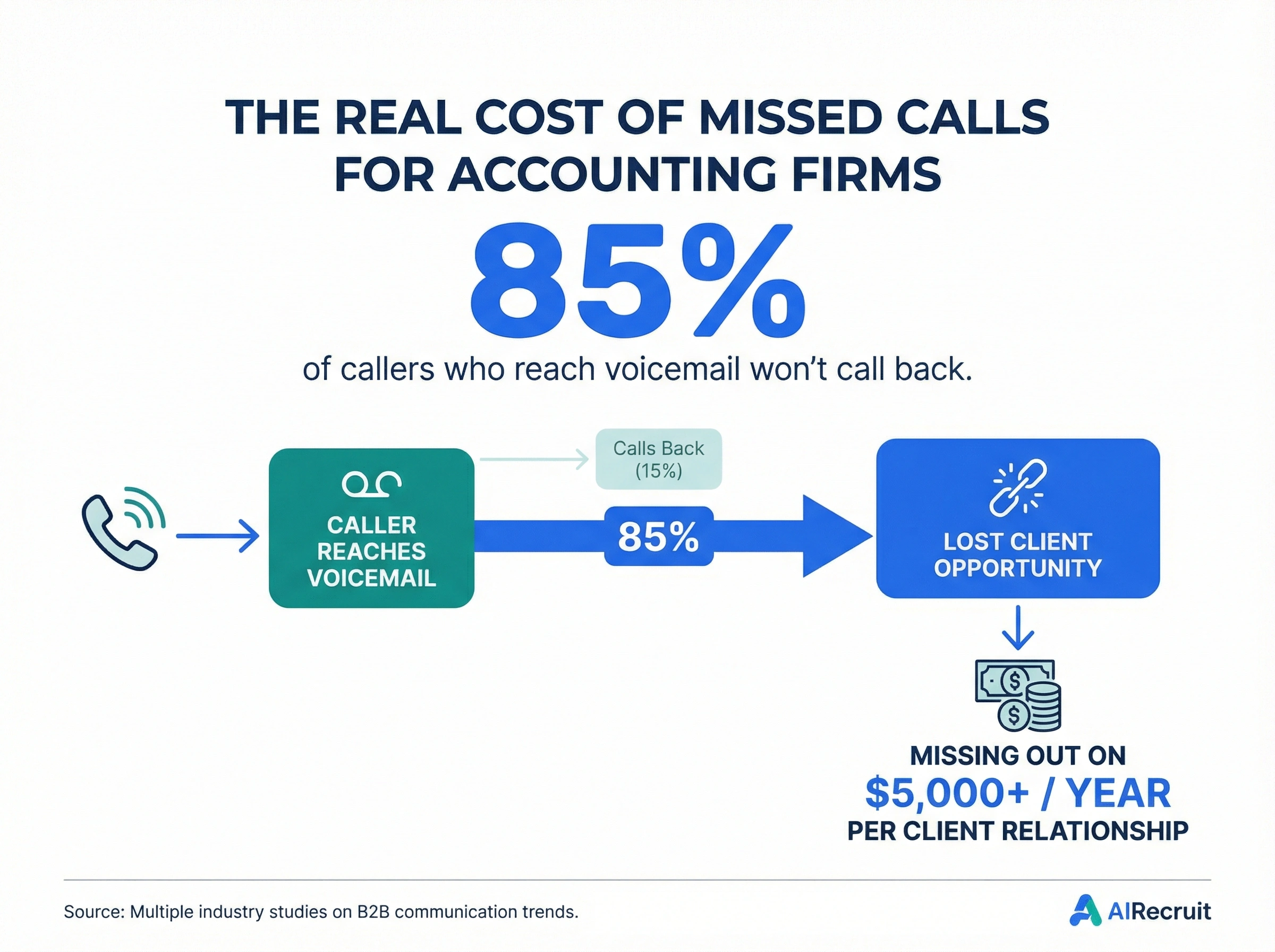
Here's what makes this painful for CPAs specifically: a single new client relationship can be worth $5,000 or more annually. That referral who called while you were knee-deep in a return? They're not leaving a voicemail. According to multiple studies, roughly 85% of callers who reach voicemail won't call back. They'll just call the next firm on their list.
And it's not just new clients you're losing. Existing clients who can't reach you start wondering if they picked the right accountant. About one-third of clients will switch to a competitor after just one bad phone experience. During tax season, when anxiety about deadlines runs high, that number probably climbs even higher.
The math is brutal. If your firm misses even five potential new client calls per month during the January-to-April rush, you could be leaving $25,000 or more in annual recurring revenue on the table. Every single year.
Four phone mistakes that quietly drain accounting firms
Most accountants don't think of their phone system as a revenue problem. But it is. Here are the four mistakes I see most often.
1. Treating tax season like a staffing problem
When call volumes spike by 40% or more during tax season, the instinct is to hire a temp or ask the office manager to cover the phones. But here's the issue: your callers have technical questions. "Can I deduct my home office?" "Do I need to file quarterly estimates?" A temp receptionist can't answer those. They take a message, and by the time someone calls back, the caller has already moved on.
The staffing approach also creates a training bottleneck. Every January, you're onboarding someone new who doesn't know your client base, your filing preferences, or how you like calls handled. By the time they're up to speed, it's March. And by April 16th, they're gone.
Honestly? Throwing more bodies at the phone problem is a waste of money for most small firms. What you actually need is something that can answer the common questions on its own and only pull in your team when it matters.
2. Going dark after 5 PM during crunch time
CPAs regularly work until 9 or 10 PM during busy season. But the phones stop at 5. Think about who's calling after hours: small business owners who finally got a break from their own workday. They're calling at 6:30 PM because that's when they have time. No answer means no engagement. And they won't remember to call back tomorrow.
Here's what makes this worse: the after-hours callers are often your highest-value prospects. A restaurant owner wrapping up dinner service at 9 PM. A contractor who finished a job site visit at 6. A physician closing the office at 7. These people run their businesses during the day, just like you. The only time they can deal with their taxes is evenings and weekends. If your phone goes dark at 5, you're invisible to exactly the clients you want most.
3. Letting routine calls eat billable time
Here's a question worth asking: how much of your phone time is actually productive? If you tracked it, you'd probably find that 60-70% of inbound calls during tax season are repetitive. "What's your fax number?" "Where do I drop off documents?" "Can you extend my deadline?" "How much do you charge for a basic 1040?"
These calls don't need a CPA. They don't even need a human. But they keep pulling your team away from the work that actually generates revenue.
4. Missing the window on high-value leads
New client inquiries don't wait. When a business owner calls looking for help with their corporate tax filing, they're calling two or three firms. The firm that answers, qualifies the lead, and books a consultation first wins the client. It's that simple. And when your entire team is heads-down on deadline work, those calls go unanswered.
What makes accounting calls different from every other industry?
AI receptionists aren't new. But accounting firms have specific needs that generic answering services don't handle well. Understanding this difference matters.
First, there's the deadline factor. Unlike a landscaping company or a salon, accounting work is driven by hard regulatory deadlines. A client calling about a filing extension on April 14th needs a real answer, not just a promise that someone will call back. The stakes are financial penalties and legal compliance, not a missed haircut.
Second, accounting calls require context. Callers use industry terminology: W-2s, 1099s, Schedule C, estimated payments, S-corp elections. A good AI receptionist for accounting firms needs to understand these terms and route calls based on what the client actually needs, not just take a generic message.
Third, there's the confidentiality expectation. Clients share sensitive financial information. They expect a professional, trustworthy first interaction. A clunky phone tree or a confused temp doesn't inspire confidence.
And fourth, accounting firms deal with seasonal surges that are more extreme than almost any other professional service. Call volumes don't just increase gradually. They spike dramatically starting in January and peak in April. Then they spike again around quarterly filing dates and year-end planning season. You need a phone system that can handle 5x normal volume without breaking a sweat.
How does an AI receptionist actually handle accounting scenarios?
An AI receptionist for accounting firms does more than answer and transfer calls. It acts like a knowledgeable front desk person who never takes a sick day and doesn't need training every January.
Here's what that looks like in practice:
Tax season FAQ handling. A client calls at 7 PM asking what documents they need to bring for their appointment. The AI answers with your firm's specific checklist: W-2s, 1099s, last year's return, mortgage interest statement, charitable donation receipts. No hold time. No voicemail. Just a clear answer.
Appointment scheduling. A new prospect calls wanting to book a consultation. The AI checks your calendar, finds the next available slot, books it, and sends a confirmation email. Your team doesn't even know it happened until they see the appointment on their schedule the next morning.
Smart call routing. A client calls with a question about their corporate return. The AI identifies the complexity, checks which partner handles corporate accounts, and transfers the call directly. If that partner is unavailable, it takes a detailed message with the specific tax topic so the callback is productive.
Lead qualification. A caller asks about your services. The AI asks qualifying questions: "Is this for personal or business taxes?" "What type of business entity?" "Have you filed with us before?" By the time your team gets the lead, it's already categorized and prioritized.
Extension request handling. In early April, you'll get dozens of calls from clients who won't make the deadline. The AI can explain the extension process, let them know what Form 4868 covers, and schedule a quick call with their accountant to confirm. That saves your team 5-10 minutes per call, multiplied by dozens of calls.
Client onboarding. When a new client signs on, there's a wave of back-and-forth: engagement letter signatures, document requests, payment setup, questionnaire completion. An AI receptionist handles inbound calls about all of this. "I signed the engagement letter, what's next?" "Where do I upload my documents?" "Do you need my last year's return from my old accountant?" These calls get resolved instantly instead of piling up on someone's callback list.
Multi-location coordination. For firms with more than one office, the AI routes calls to the right location based on the caller's area code, their assigned partner, or the service they need. A client in your downtown office shouldn't be routed to your suburban location just because someone didn't update a phone tree.
The real ROI: what the numbers look like for your firm size
Let's skip the vague promises and do some actual math. The ROI of an AI receptionist for accounting firms varies based on practice size, but the numbers work out favorably at every level.
Solo practitioners and small practices (1-3 CPAs)
You're probably answering your own phone or relying on an office manager who wears ten hats. Every phone interruption costs you roughly 23 minutes of refocused work time, according to research from the University of California, Irvine. If you get interrupted by phone calls 8 times a day during tax season, that's over 3 hours of lost productive time. Daily.
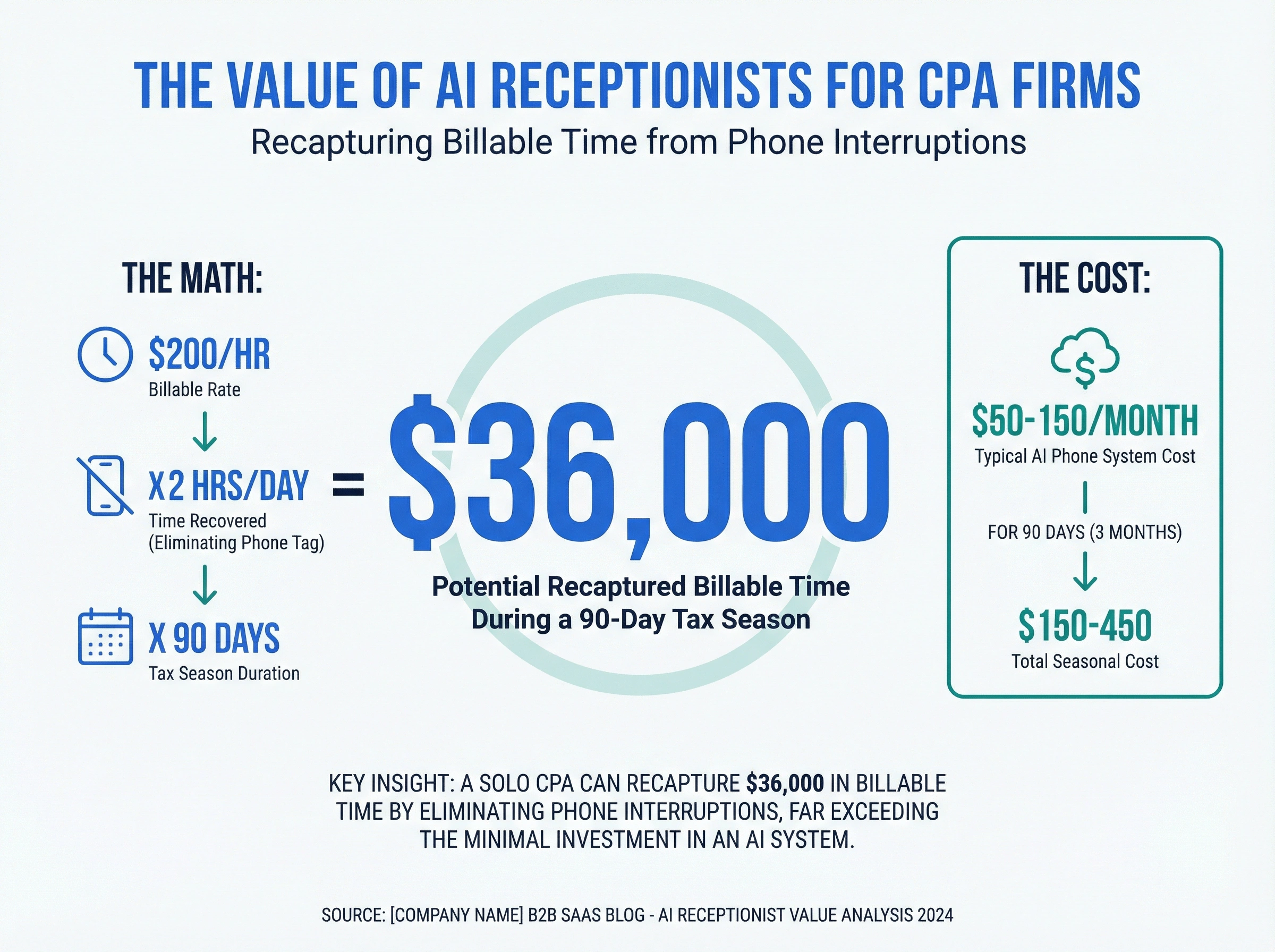
An AI receptionist handles the routine calls (probably 60-70% of your volume) without interrupting you. If you bill at $200/hour and recover even 2 hours per day, that's $400/day in recaptured billable time. Over a 90-day tax season, that's $36,000.
The cost of an AI phone system? Usually $50-150/month. The math isn't even close.
It's 3 PM on a Wednesday in March. You're working through a complicated partnership return. The phone rings. It's a prospective client asking about your fees for a basic individual return. You stop, answer, spend four minutes on a call that could've been handled by an FAQ page. Now you need another 15-20 minutes to get back into the flow of that partnership return. That's not a minor annoyance. Over a full tax season, those interruptions add up to weeks of lost productivity.
Mid-sized firms (4-10 professionals)
At this size, you've probably got a dedicated receptionist or a shared admin handling calls. But during tax season, that person is overwhelmed. Calls get missed, hold times stretch, and client satisfaction drops.
An AI receptionist works alongside your existing team. It handles overflow, after-hours calls, and the repetitive questions that don't need human judgment. For a firm with 500+ client relationships, capturing even 10 additional new clients per tax season (at $3,000 average annual value each) means $30,000 in new recurring revenue. Plus reduced stress on your admin staff, which means less turnover.
Growing firms (10+ professionals)
Larger firms face a coordination challenge. Multiple partners, different specialties, varied availability. Calls need to reach the right person, and generic phone trees frustrate clients who don't know whether their question is about "individual taxes" or "business advisory."
An AI receptionist that understands your team structure routes calls intelligently. It knows Partner A handles estates and trusts, Partner B handles small business, and the new associate handles straightforward individual returns. No more bouncing clients between extensions.
The data isn't entirely clear on exact ROI figures at this scale because it varies so much by market and specialization. But firms we've talked to consistently report that faster response times alone account for a 15-25% increase in new client conversion rates.
There's another benefit at this size that's easy to overlook: staff retention. According to industry surveys, burnout is the top reason accountants leave firms. When your receptionist or admin team is drowning in phone calls during peak periods, they burn out fast. Turnover in admin roles costs roughly 50-75% of an annual salary when you factor in recruiting, training, and lost productivity. An AI receptionist that takes the pressure off your front desk team during crunch time doesn't just save money on calls. It helps you keep the people who hold your operations together.
Beyond tax season: year-round value for accounting practices
Here's something that often gets overlooked. Tax season gets all the attention, but accounting firms need consistent phone coverage all year.
Quarterly estimated tax reminders. Clients forget. An AI system can handle inbound calls from confused clients asking about quarterly deadlines, due dates, and payment amounts. It can even provide reminders proactively.
Year-end tax planning. October through December is when smart clients call about year-end strategies. These are high-value calls from your best clients. Missing them because your team is at a holiday party or a CPE seminar means missing revenue opportunities.
Audit and review season. If your firm handles audits, you know the drill: intense periods of focused work interrupted by phone calls from the client being audited, their banker, their attorney. An AI receptionist screens and prioritizes these calls so your audit team stays focused.
Bookkeeping clients. Monthly bookkeeping clients call with questions about categorizing transactions, reconciling accounts, or accessing reports. These are usually quick, routine calls that an AI can handle or route efficiently.
Advisory services growth. More firms are moving toward advisory and CFO services. These higher-value offerings require more client communication, not less. An AI receptionist makes sure you never miss a call from a $50,000/year advisory client because everyone was in a meeting.
New client acquisition. Tax season isn't the only time people look for accountants. Life events drive year-round inquiries: starting a new business, buying property, getting married, inheriting assets. These callers are often shopping around and pick the firm that responds first. An AI receptionist that answers immediately, asks the right qualifying questions, and books a consultation gives you a competitive edge over firms where the phone rings six times and goes to voicemail.
So is an AI receptionist only useful during tax season? Not even close. The firms getting the most value use it as their year-round front desk, handling the routine calls that don't need a CPA's brain and making sure the important calls reach the right person fast.
What to look for in an AI receptionist for accounting firms
Not every AI phone system works well for accountants. Here's what actually matters when you're evaluating options.
Industry-specific training. Can you teach the AI about your services, your team, and the specific questions your clients ask? A system that lets you customize responses for tax topics, document requirements, and pricing questions will save you far more time than a generic call answering tool.
Calendar and scheduling integration. Your AI should book appointments directly into your scheduling system. Bonus points if it can handle different appointment types: "30-minute new client consultation" vs. "15-minute document drop-off" vs. "1-hour business tax planning session."
After-hours coverage. This is non-negotiable. If the AI only works during business hours, you're missing the exact calls that matter most: after-hours inquiries from busy professionals.
Call routing intelligence. For firms with multiple staff members, the AI needs to route calls based on topic, not just department. "I have a question about my LLC" should go to a different person than "I need to pick up my completed return."
Detailed call summaries. When the AI does take a message, it should provide context: what the caller asked, what was discussed, and what follow-up is needed. A message that says "John called, wants a callback" is almost useless. A message that says "John called about converting his sole proprietorship to an LLC before year-end, wants to discuss tax implications, available Tuesday or Thursday afternoon" is actionable.
Data privacy and security. Your clients trust you with sensitive financial information. Your phone system needs to match that trust with encryption, controlled access, and clear data handling policies. Don't settle for "we take security seriously" on a website. Ask specific questions about how call data is stored and who can access it.
Scalability during peak periods. Your AI should handle 50 calls the same way it handles 5. Some systems slow down or drop quality when volume increases. Ask about concurrent call handling and whether there are per-minute charges that could spike your costs during busy months. The last thing you want is a surprise $500 phone bill in April.
Ease of setup and customization. You're an accountant, not a developer. The system should let you update your FAQs, adjust call routing, and change your greeting in minutes, not hours. If you need to call tech support every time you want to add "We're closed for President's Day" to your message, it's the wrong tool.
How dialnote helps accounting firms capture every client call
Most of the pain points I've described above come down to one thing: accounting firms need a phone system that's as sharp as their CPAs, available when their clients call, and smart enough to handle the basics without human help.
That's exactly what dialnote was built to do.
dialnote's AI receptionist answers calls in a natural, conversational voice. You can train it on your firm's specific FAQs, from document checklists and filing deadlines to pricing for common services. It doesn't just take messages. It has real conversations with your callers.
When a new prospect calls, dialnote qualifies the lead by asking the right questions: personal or business taxes, entity type, and what they're looking for. It books consultations directly into your calendar and sends confirmation details to both you and the client. By the time you sit down for that meeting, you already know what the client needs.
For existing clients, dialnote's call routing sends calls to the right team member based on the client's needs. No more phone trees. No more "let me transfer you" three times. And with AI call summaries, every conversation gets documented automatically, so nothing falls through the cracks.
The call analytics dashboard shows you patterns you'd never notice otherwise. Which days get the most calls? What questions come up repeatedly? Where are you losing callers? This data helps you staff smarter, update your FAQs, and spot issues before they cost you clients.
And because dialnote works 24/7, those after-hours calls from business owners who can only call at 7 PM? They get answered, qualified, and scheduled. Not sent to a voicemail black hole.
Need a dedicated business phone number for your practice? dialnote makes that simple too. You can set up local or toll-free numbers and even port your existing number so clients don't have to update their contacts.
During tax season, when your phone system needs to handle 3-5x normal volume without a hiccup, dialnote scales automatically. No temp hires to train. No extra phone lines to install. Just consistent, professional call handling whether it's January 15th or July 15th.
If you're curious how other professional services firms use AI phone systems, check out how law firms and insurance agencies are solving the same missed-call problem. The challenges are different, but the pattern is the same: answer faster, qualify smarter, and don't let good leads slip away.
The accounting firms that pick up the phone will pick up the clients
The accounting industry is going through a rough patch right now. According to the AICPA, the U.S. accounting workforce has shrunk by 17% since 2020, with over 300,000 professionals leaving the field. According to a FloQast survey, 99% of accountants report some level of burnout.
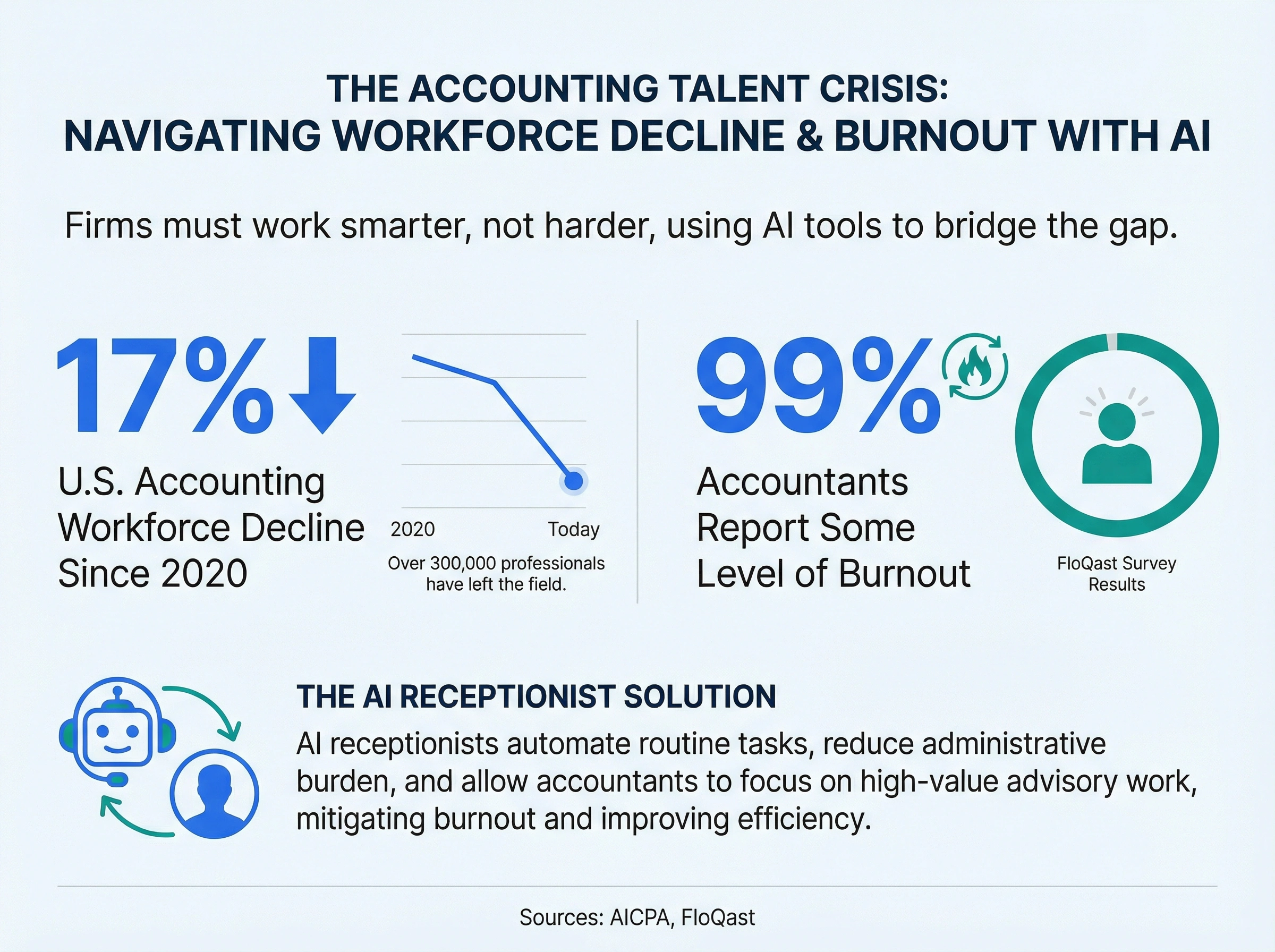
The firms that survive and grow won't be the ones working longer hours. They'll be the ones working smarter.
I've worked with enough B2B companies to know that the businesses which grow fastest aren't always the most talented. They're the most responsive. The law firm that calls back in 10 minutes beats the better lawyer who calls back tomorrow. The same applies to accounting. The CPA who answers the phone, even through an AI, wins the client over the CPA with better credentials who lets it ring.
An AI receptionist for accounting firms isn't about replacing your team. It's about giving them back the time they're currently wasting on calls that don't need their expertise. It's about making sure your firm answers when opportunity calls, literally.
Think about where you want your firm to be in three years. More clients? Higher-value engagements? Less stress during tax season? All of those outcomes depend on one basic thing: being available when people reach out. An AI receptionist handles that availability around the clock, while your team focuses on the work that actually requires their license and experience.
Will every accounting firm adopt AI phone systems? Eventually, probably. But right now, the firms that move first have a real advantage. Their clients get better service. Their teams get less burned out. And the leads that used to slip away? They actually get answered.
That's not a small thing when you're running a practice.
Frequently asked questions
Most AI receptionist plans run between $30-150/month, far less than human answering services that charge $350-500/month. You'll also save billable hours your staff currently wastes on routine phone tasks.
Yes. You can train it on your firm's FAQs, like filing deadlines, document checklists, and pricing for common services. It won't give tax advice, but it'll handle the repetitive questions that eat up your team's time.
Modern AI voice agents sound natural and conversational. Most callers won't notice a difference, especially for routine tasks like scheduling or answering office hours questions.
Many AI phone systems connect with popular business tools through integrations. dialnote, for example, works with CRMs and scheduling platforms to keep your client data in sync.
Reputable AI phone systems use encryption and follow strict data handling protocols. Look for providers that offer call recording controls and data retention policies that match your firm's compliance needs.

Written by
Lancelot Dsouza
Chief Marketing Officer, SmartReach.io
Lancelot Dsouza is the Chief Marketing Officer at SmartReach.io, where he built the Marketing, Sales, and Customer Success verticals from the ground up. With over 25 years of experience spanning digital marketing, business development, and strategic...
Lancelot Dsouza is the Chief Marketing Officer at SmartReach.io, where he built the Marketing, Sales, and Customer Success verticals from the ground up. With over 25 years of experience spanning digital marketing, business development, and strategic...
Related Articles
Best AI Receptionist Software For Businesses Ranked
Compare the best AI receptionist software for businesses by 10-user cost, per-minute AI fees, IVR, call queueing, and real reviews. Pick the right tool.
Does Your Business Need an After Hours Answering Service?
Learn how an after hours answering service captures missed calls, compare pricing for live vs AI options, and set up 24/7 coverage for your business.
AI Phone Answering Service vs Virtual Receptionist?
Compare AI phone answering services and virtual receptionists side by side. Find which option fits your business, budget, and call volume.